

Best AI SEO Agency in UK
AI SEO, LLM SEO, or GEO (Generative Engine Optimisation)to appear in Chat GPT, Gemini, AI Overviews, Google’s AI Mode.
Is Your Website AI-Proof? Take Our FREE Generative SEO Readiness Check
Generative Engine Optimisation (GEO) is a relatively new field that involves optimising content for AI search engines. As AI becomes increasingly sophisticated, it’s essential to adapt our content strategies to align with how these algorithms process and understand information.
1. Optimising for Web Search: An AI-First Approach
While traditional SEO principles still hold significant value, it’s crucial to consider how AI influences search engine results. Here are some key strategies:
- AI-Friendly Content:
- Long-form content: AI models often prefer in-depth, comprehensive content.
- Clear structure: Use headings, subheadings, and bullet points to improve readability and AI comprehension.
- Natural language: Write in a conversational tone that’s easy for both humans and AI to understand.
- Keyword Optimisation:
- Semantic keywords: Use tools like Google Keyword Planner and SEMrush to identify relevant keywords and LSI keywords.
- Natural keyword placement: Integrate keywords naturally into your content, avoiding keyword stuffing.
- Technical SEO:
- Mobile-friendliness: Ensure your website is optimised for mobile devices.
- Page speed: Improve website loading speed to enhance user experience and AI crawling.
- HTTPS: Use HTTPS to secure your website and boost credibility.
2. Optimising for AI Overviews
AI models often generate overviews of content. To optimise for these overviews:
- Clear and concise introductions: The introduction should provide a clear overview of the topic.
- Strong thesis statement: A strong thesis statement will help AI models understand the main point of your content.
- Well-structured content: Use clear headings and subheadings to guide the AI’s understanding.
3. Prompt Engineering: Crafting Effective Queries for AI
Prompt engineering involves crafting precise and effective queries to elicit the desired response from AI models. Here are some tips:
-
- Be specific: Clearly state your query, avoiding ambiguity.
- Use keywords: Incorporate relevant keywords to guide the AI’s response.
- Experiment with different phrasings: Try different approaches to find the most effective prompt.
<li”>Leverage question-based prompts: Question-based prompts can help you get more focused and informative responses.
4. Keyword Optimisation for AI: The Power of LSI Keywords
Latent Semantic Indexing (LSI) keywords are words and phrases related to your primary keyword. By incorporating LSI keywords, you can improve your content’s semantic relevance and make it more accessible to AI.
5. E-E-A-T: A Cornerstone of AI-Era SEO
E-E-A-T (Expertise, Experience, Authority, Trustworthiness) remains crucial in the age of AI. To build a strong E-E-A-T profile:
- Establish expertise: Become an authority in your niche through high-quality content, speaking engagements, and industry certifications.
- Build trust: Use reliable sources, cite credible references, and avoid making unsubstantiated claims.
- Enhance authority: Build backlinks from reputable websites and actively engage with your audience.
6. Using the Correct Schema
Schema markup helps search engines better understand the content of your website. By using the correct schema for your content, you can improve your chances of appearing in rich snippets and knowledge graphs.
Real-world example: A tech blog could optimise an article on “AI in healthcare” by:
- Using long-form content to provide a comprehensive overview.
- Incorporating LSI keywords like “machine learning,” “deep learning,” and “natural language processing.”
- Structuring the content with clear headings and subheadings.
- Crafting effective prompts for AI tools to generate summaries and insights.
- Building backlinks from reputable medical websites.
By following these strategies, you can optimise your content for both human and AI audiences, improving your search engine rankings and driving organic traffic.
Real Examples Showing How Generative Engines Work
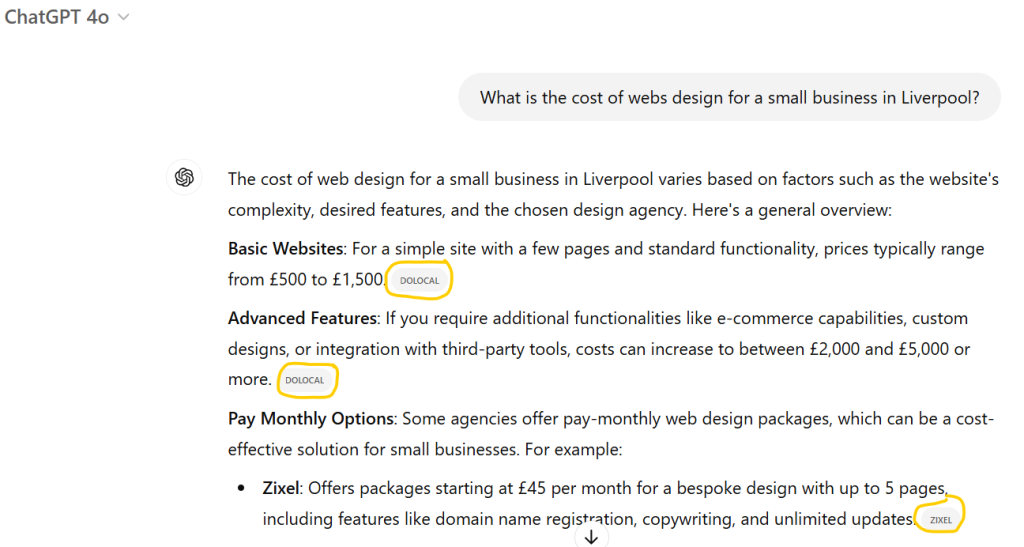
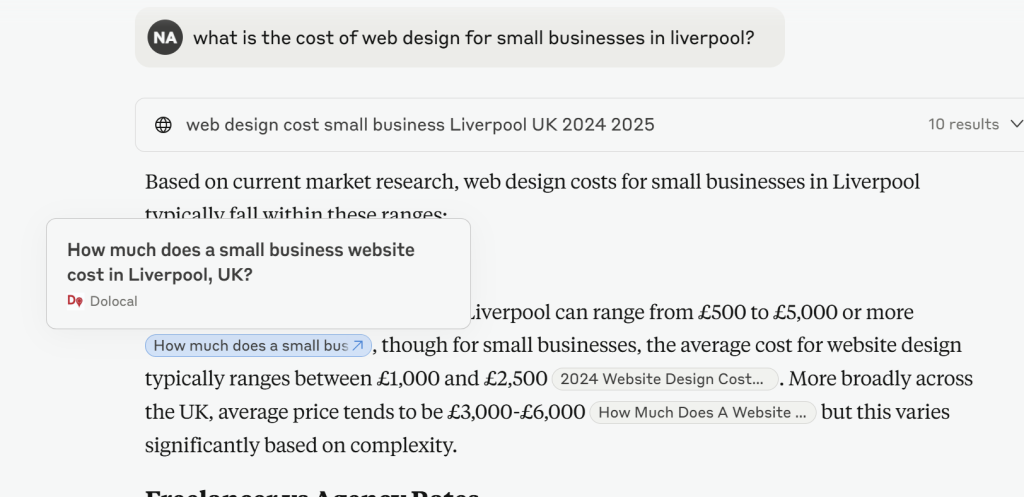
As an experiment, and to show you how they work, we asked ChatGPT, “What is the cost of web design for small business in Liverpool?”
It went and searched the web and gave us a summary of what information it found. Not only did it show us the detailed answer but also included the sources (circled in Yellow).
So, rather than browsing a whole page on Google, going from one website to the other, it has provided a concise reply to our question.
ChatGPT Results
Claude Results
AI Overviews Results

AI Mode Results

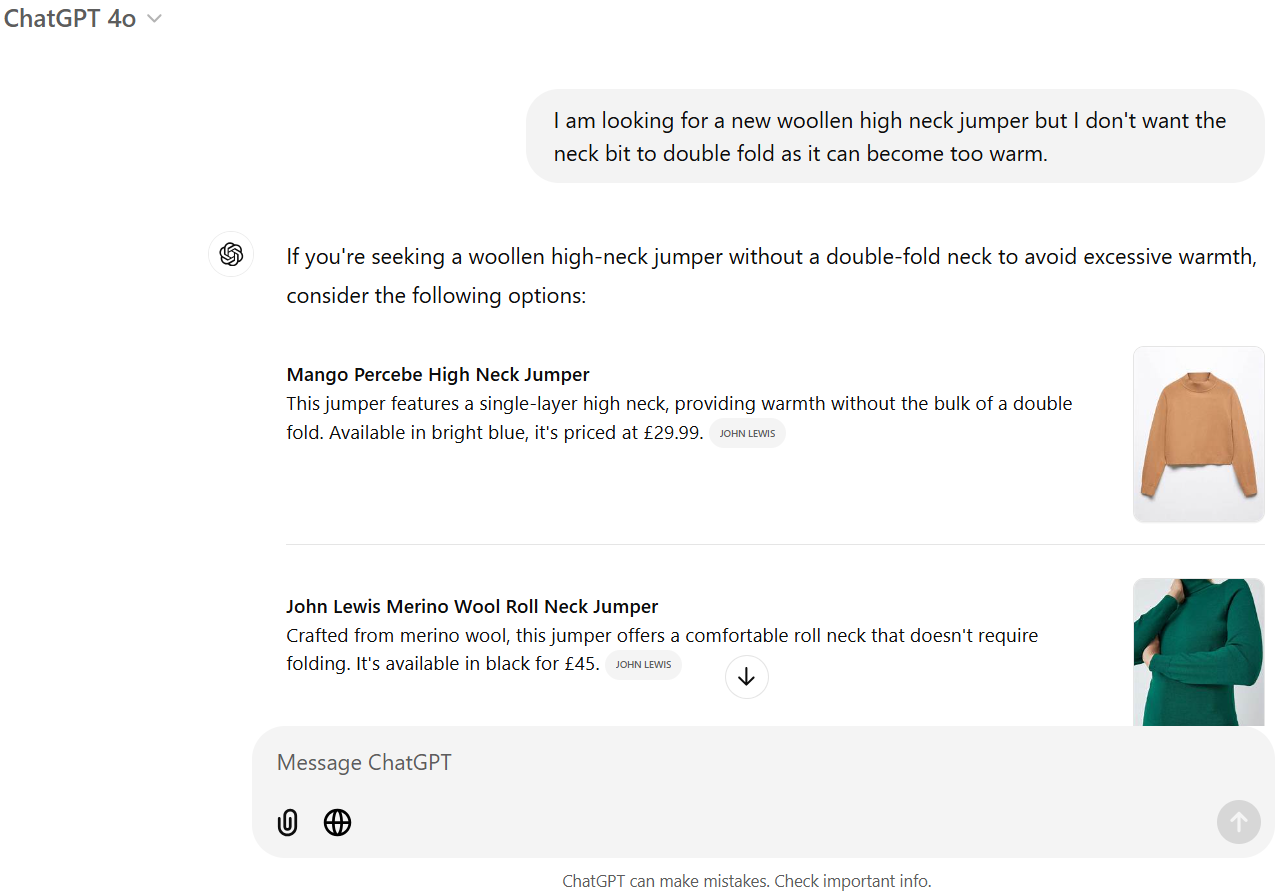
Then we asked it a shopping questions. This is a question from someone looking for something which generally, many companies may have but, with a specific requirement it is extremely time consuming on a web search.
As you can see that ChatGPT has found precisely what this person was looking for, within a few seconds.
These were very cleverly selected, as you can see in the details that they have the specific types of necks which match what this person was looking for. It clearly understood and used ‘contextual relevance’ to provide these results.
Learn more
Generative Engine Optimisation (GEO), also know as SEO for AI, is the practice of tailoring content for generative AI systems like ChatGPT, ensuring it is structured, contextually relevant, and authoritative. It complements traditional SEO by enhancing machine comprehension and visibility in AI-generated responses.
Generative Engine Optimisation (GEO) is an emerging concept in the digital marketing landscape, focusing on optimising content for generative AI models. Unlike traditional Search Engine Optimisation (SEO), which tailors content to rank highly on search engine results pages (SERPs), GEO ensures that content is structured, formatted, and enriched in a way that makes it more accessible and useful to generative AI systems. These systems, such as ChatGPT or Google’s Bard, are increasingly becoming the go-to tools for users seeking answers, recommendations, and insights. GEO involves understanding how these AI models process and prioritise information, ensuring that your content is both contextually relevant and sufficiently detailed to be considered authoritative. This includes using natural language that mirrors user intent, incorporating semantic richness, and providing factual, well-researched information. Additionally, GEO leverages metadata, structured data, and context clues that enhance machine comprehension, ensuring that your content surfaces during AI-generated responses. As generative AI continues to influence how consumers interact with information, businesses and creators must embrace GEO to maintain visibility and relevance. By aligning content strategies with the capabilities and needs of generative AI, GEO represents the next frontier in digital marketing, paving the way for deeper engagement with audiences who rely on these advanced tools. As such, it is not merely an alternative to SEO but an essential complement in a world where AI-driven content consumption is on the rise.
The term “Generative Engine Optimisation” (GEO) was introduced in a 2023 research paper titled “GEO: Generative Engine Optimization” by Pranjal Aggarwal and colleagues (updated on 28 Jun 2024). This paper formalised the concept of generative engines—search systems that utilise large language models (LLMs) to generate and summarise information in response to user queries. The authors proposed GEO as a framework to help content creators enhance their content’s visibility within these AI-driven search engines. (Source arXiv)
With generative engines here to stay, we must ensure the creator economy is not disadvantaged. To address this, we introduce Generative Engine Optimization (GEO), the first novel paradigm to aid content creators in improving their content visibility in generative engine responses through a flexible black-box optimization framework for optimizing and defining visibility metrics.
Pranjal Aggarwal, Vishvak Murahari, Tanmay Rajpurohit, Ashwin Kalyan, Karthik Narasimhan, Ameet Deshpande.
Generative engines are like super-smart computers that take a question or request you type in and create a detailed, personalised response for you. They don’t just search for answers like traditional search engines (e.g., Google); they use advanced artificial intelligence to understand what you’re asking and then “generate” a reply by combining information from loads of sources.
Here’s how they work in simple terms:
- Understanding Your Question: First, the generative engine reads your input, whether it’s a question, a sentence, or just a few keywords. It uses natural language processing (NLP) to understand not just the words but also the meaning behind them.
- Searching for Information: Instead of showing a list of links, like a regular search engine, the generative engine dives into its database, which is filled with knowledge it learned from books, articles, websites, and other data.
- Creating a Response: Using what it knows, the engine doesn’t just copy-paste answers—it pieces together a response in its own words, making it as clear and relevant to your question as possible. It’s like having a really clever friend explain something to you.
- Learning Over Time: These engines get better the more they’re used. They learn patterns, improve their ability to understand questions, and refine their answers based on feedback.
So, a generative engine works by being both smart and creative, helping you get detailed and specific answers without having to dig through loads of websites yourself!
No, AI Search Optimisation (GEO) is not the same as Search Engine Optimisation (SEO), although they share some similarities and can complement each other.
Here’s how they differ:
1. Purpose
- SEO: Focuses on improving a website’s visibility and ranking on traditional search engines like Google or Bing.
- GEO: Aims to optimise content for generative AI systems like ChatGPT, Google Bard, or other AI models that generate and summarise responses rather than displaying a list of links.
2. How They Work
- SEO: Relies on keywords, metadata, backlinks, and technical elements like page speed to ensure content ranks well on search engine results pages (SERPs).
- GEO: Focuses on making content readable, contextually relevant, and structured in a way that AI systems can understand and use when generating answers. It might include semantic enrichment, FAQs, or structured data to align with AI processing.
3. User Interaction
- SEO: Targets users who browse through search results to find the most relevant link to click.
- GEO: Targets users who directly interact with AI to get instant, detailed answers without the need for further navigation.
4. Output
- SEO: Drives traffic to websites by encouraging users to click through.
- GEO: Generates content that may not always lead users to a specific website but increases brand visibility within AI-generated answers.
While both aim to make content discoverable, SEO is about pleasing search engines, whereas GEO is about aligning with generative AI systems. As AI tools become more popular, businesses will likely need to adopt both strategies for a holistic digital presence.
| Aspect | SEO (Search Engine Optimisation) | AI Overviews | GEO (Generative Engine Optimisation) |
|---|---|---|---|
| Purpose | Improve website visibility and rank in search engine results. | Provide concise summaries or answers within an AI tool. | Optimise content to be effectively used by generative AI systems. |
| Key Focus | Keywords, backlinks, metadata, and technical SEO factors. | Delivering quick, relevant information directly to the user. | Semantic relevance, structured data, and enriched context. |
| User Experience | Users browse multiple links to find the most relevant information. | Users receive instant, summarised answers without needing to leave the platform. | Users get personalised, detailed responses generated from optimised content. |
| Main Outcome | Drives traffic to websites through higher rankings. | Keeps users engaged on the AI platform with concise answers. | Ensures brand or content visibility within AI-generated answers. |
| Content Requirement | High-quality, keyword-rich content that aligns with search engine algorithms. | Easily digestible, well-structured content for quick AI summarisation. | Detailed, context-aware, and machine-readable content for AI comprehension. |
| When to Use | When targeting traditional search engines for website traffic. | When engaging with audiences through AI assistants or chat tools. | When optimising for emerging generative AI systems like ChatGPT or Bard. |
This comparison highlights how each strategy addresses different user needs and technologies, emphasising the growing importance of GEO in the age of generative AI.
As of November 2024, here’s a comparison of various AI search platforms and traditional search engines, focusing on their estimated monthly active users, estimated monthly searches, and top 5 search queries:
| Platform | Estimated Monthly Active Users | Estimated Monthly Searches | Top 5 Search Queries |
|---|---|---|---|
| Google Search | Over 1 billion | Approximately 12 billion | 1. YouTube 2. Facebook 3. Weather 4. News 5. Maps |
| Microsoft Bing | 100 million | Data not specified | 1. Weather 2. News 3. Sports scores 4. Stock market 5. Travel information |
| Yahoo! Search | 700 million | 3.4 billion | 1. News 2. Finance 3. Sports 4. Entertainment 5. Shopping |
| ChatGPT | 200 million | Approximately 3.1 billion | 1. Coding assistance 2. Homework help 3. Writing prompts 4. General knowledge questions 5. Language translation |
| Google Gemini | 4.62 million daily users | Data not specified | 1. Current events 2. Travel recommendations 3. Health information 4. Technology news 5. Recipe ideas |
| Microsoft Bing AI | Data not specified | Data not specified | 1. Weather updates 2. Sports scores 3. Stock market information 4. Local business searches 5. Entertainment news |
Note: The above figures are based on available data and estimates as of November 2024. Exact numbers for some platforms may not be publicly disclosed.
Recent Developments:
- ChatGPT has seen significant growth, doubling its weekly user base to over 200 million since November of the previous year.
- Google Gemini experienced a substantial increase in traffic, with visits rising from 49.7 million in April to 142.6 million in May 2024.
- Microsoft Bing AI continues to integrate AI capabilities into its search engine, enhancing user experience with AI-driven features.
These platforms are continually evolving, with user engagement and search patterns reflecting their growing integration into daily information-seeking activities.
DoLocal Digital Marketing Agency in Liverpool specialises in Generative Engine Optimisation (GEO). This innovative approach to SEO focuses on optimising content for AI-powered search engines.
In the evolving landscape of search, AI algorithms are increasingly influencing search results. GEO recognises this shift and adapts traditional SEO strategies to align with how AI-driven search engines process and rank content.
DoLocal’s expertise in GEO enables them to help businesses:
- Understand user intent: By analysing user queries and behaviour, DoLocal can tailor content to precisely address user needs.
- Create high-quality, informative content: GEO emphasises creating valuable, engaging content that provides comprehensive answers to user questions.
- Improve search engine rankings: By optimising content for AI algorithms, DoLocal can help businesses achieve higher search engine rankings and increased visibility.
- Enhance user experience: GEO focuses on creating a seamless user experience, ensuring that visitors can easily find the information they’re looking for.
By embracing GEO, DoLocal Digital empowers businesses in Liverpool to stay ahead of the curve in the ever-changing world of search engine optimisation.


