
Quantum SEO Service
Predictive SEO That Helps Your Website Appear in AI Results:
Intent Driven Analysis for Optimal Content That Converts – Driving More Organic Traffic
The era of reactive SEO is over. Quantum SEO is the necessary evolution of our Generative AI Optimisation (GEO) services, designed to give enterprise B2B and B2C brands the unfair competitive edge they need to lead AI Search.
We are UK’s first digital agency to offer Quantum SEOTM bringing measurable, Quantum-Inspired AI algorithms to enterprise SEO strategy.
What is Quantum SEO?
Move Beyond Guesswork: Embrace Predictive Optimisation
DoLocal’s Quantum SEO is a comprehensive approach to dominating both traditional search engines and AI-powered platforms like ChatGPT, Perplexity, and Google’s AI Overviews. Using advanced AI analysis and strategic optimisation, we ensure your content gets discovered, cited, and recommended wherever your customers are searching—now and in the future.
What you get:
- AI-Powered Quantum SEO Audit – Deep analysis of your current visibility across all search platforms, identifying exactly where you’re missing opportunities
- Strategic Content Creation – Authority-building content that positions you as the go-to expert, optimised for both human readers and AI systems
- Intelligent Linking Architecture – Strategic internal connections that amplify your topical authority and guide search engines through your expertise
- Cross-Platform Optimisation – Content structured to perform in traditional Google results, AI citations, featured snippets, and voice search simultaneously
- Continuous Monitoring & Refinement – Ongoing tracking and iteration to keep you ahead as search technology evolves
The result: Maximum visibility where your customers actually search, future-proofed against the AI revolution transforming how people find information online.
Key Benefits of Quantum SEO
Prediction: Forecast content performance and ranking shifts before they happen.
Scale: Instantly optimise hundreds of pages using analytical and adaptive AI agents.
Results: Achieve hyper-efficient targeted intent based growth focused purely on measurable ROI and conversion.
Our Quantum SEO Process
Phase 1: Predictive Audit & Goal Setting (AI Analysis)
1. Site Snapshot
A comprehensive baseline assessment of your website’s current state across all critical SEO dimensions. This involves cataloguing existing content assets, technical infrastructure, topical authority clusters, and current search visibility. Think of this as capturing your site’s “quantum state” before any intervention—understanding what content exists, how it’s structured, current traffic patterns, and which pages hold the most authority. AI tools can rapidly audit hundreds or thousands of pages to identify patterns in performance, content gaps, and structural weaknesses that would take weeks to analyse manually.
2. Intent Mapping
The process of aligning your content with the various search intents your target audience exhibits throughout their journey. This goes beyond simple keyword research to understand the why behind searches—whether users seek information, comparison, transaction, or navigation. AI analysis can cluster queries by semantic similarity and user intent, revealing opportunity spaces where your content could intercept users at critical decision points. This mapping creates a strategic framework showing which intents you currently serve and which remain unaddressed.
3. AI Visibility Check
An assessment of how well your content appears in AI-powered search experiences, including ChatGPT, Claude, Perplexity, Google’s AI Overviews, and other LLM-based discovery tools. This isn’t just about traditional SERP rankings—it’s about whether AI systems cite, reference, or recommend your content when answering relevant queries. Testing involves prompting various AI tools with target queries to see if your content surfaces, how it’s characterised, and whether you’re positioned as an authority on key topics.
4. Define Target Gaps
Synthesising insights from the previous three steps to identify specific, actionable opportunities. These gaps might include high-value keywords you’re not targeting, intent categories you’re underserving, topics where competitors dominate, or areas where AI systems don’t recognise your authority. This step transforms audit findings into a prioritised roadmap, focusing resources on opportunities with the highest potential impact for your specific goals.
Phase 2: Content Creation & Structuring (AI Generation)
5. Authority Outline
Creating a strategic content framework that positions your material as genuinely authoritative rather than merely comprehensive. This involves structuring content around expertise signals—original research, unique insights, expert perspectives, case studies, and data that only you possess. AI can help generate outline structures that incorporate E-E-A-T signals (Experience, Expertise, Authoritativeness, Trustworthiness), suggest sections that demonstrate depth, and identify where to weave in differentiating elements that competitors can’t easily replicate.
6. Drafting the Core Content
The actual content generation phase, where AI assists in producing well-structured, semantically rich material that serves user intent whilst maintaining topical depth. This isn’t about using AI to churn out generic content—it’s about leveraging it to draft sections efficiently, suggest varied phrasings, incorporate relevant semantic entities, and maintain consistency across long-form pieces. The focus remains on creating genuinely useful content that answers questions comprehensively, with AI handling the heavy lifting of structure and initial drafting whilst human expertise adds nuance, verification, and brand voice.
7. Schema Markup Generation
Creating structured data markup that helps search engines and AI systems understand your content’s context, relationships, and meaning. AI can automatically generate appropriate schema types (Article, FAQ, HowTo, Product, etc.) based on your content, ensuring proper implementation of entities, properties, and hierarchies. This markup acts as a translation layer, making your content more “readable” to machines and increasing the likelihood it’ll be featured in rich results, knowledge panels, or cited by AI systems.
Phase 3: Optimising for Entanglement (AI Internal Linking)
8. Internal Link Strategy
Developing a sophisticated internal linking architecture that creates “entanglement” between related content pieces—strengthening topical authority signals and guiding both users and crawlers through logical content pathways. AI analysis can identify optimal linking opportunities by understanding semantic relationships between pages, suggesting contextually relevant anchor text, and predicting which connections will most effectively distribute authority. The goal is creating a web of interconnections that demonstrates comprehensive topic coverage and expertise clustering.
9. Title Superposition Testing
Testing multiple title variations simultaneously (like quantum superposition) to determine which formulations achieve optimal performance across different contexts—traditional search results, AI citations, social sharing, and user engagement. AI can generate title variants that balance keyword optimisation, click-worthiness, and semantic clarity, then help analyse performance data to identify winners. This recognises that the “perfect” title might vary depending on whether it appears in Google AI Overviews, ChatGPT responses, or social feeds.
Phase 4: Monitoring & Adaptation (AI Feedback Loop)
10. Post-Launch Analysis
Systematic monitoring of how your optimised content performs across traditional and AI-powered search channels. This involves tracking conventional metrics (rankings, traffic, conversions) alongside newer signals like AI citation frequency, feature snippet capture rate, and cross-platform visibility. AI tools can process large datasets to identify performance patterns, anomalies, and early indicators of success or underperformance—collapsing the “superposition” of multiple possible outcomes into observable results.
11. Next Iteration
Using performance data to inform continuous improvement cycles. This step involves identifying what worked, what didn’t, and why—then feeding these insights back into the process for future content efforts. AI analysis can spot patterns across successful pieces (structural elements, semantic density, linking patterns), suggest refinements to underperforming content, and help predict what adjustments will yield the greatest improvements. The quantum metaphor here reflects the iterative, observational nature of the process—each measurement affects the system and informs the next state.
This methodology treats SEO as a dynamic, probabilistic system rather than a static checklist—hence the quantum physics terminology. The focus is on using AI throughout to handle scale and complexity whilst maintaining strategic human oversight.
Why Choose DoLocal for Quantum SEO?
Choosing Quantum SEO is choosing measurable, high-growth results. As a multi award-winning UK digital agency, DoLocal is uniquely positioned to deliver this.
We were early adopters and proven experts in Generative AI Optimisation (GEO), and now we are pioneering the next level of predictive marketing. Our core brand values—transparency and measurable growth—mean you won’t just receive advanced technology; you’ll receive clear reports, predictable forecasts, and a dedicated team focused solely on helping you smash your ambitious growth goals.
Comparison Table: Quantum vs. Traditional
| Feature | Traditional SEO (Reactive) | DoLocal Quantum SEO (Predictive) |
| Data Processing | Sequential, slow, limited data inputs. | Parallel (Quantum-Inspired), immediate, massive data inputs. |
| Search Strategy Focus | Keywords and Topics. | User Intent and Semantic Relationships. |
| Ranking Approach | Wait for data, then optimise (Reactive). | Forecast performance, optimise pre-emptively (Proactive). |
| Speed/Adaptability | Weeks/Months to adjust to SERP changes. | Real-time, instant adaptation via AI agents. |
| Content Optimisation | Optimisation for density and length. | Optimisation for E-A-T, Trust, and Conversion Intent. |
FAQs about Quantum SEO
How will Google's SGE (Search Generative Experience) change content creation and strategy?
The introduction of the Search Generative Experience (SGE) by Google represents the single largest shift in search behaviour since the mobile revolution. SGE doesn’t just change the ranking algorithm; it fundamentally changes the purpose of content, moving the goalposts from ranking high to being the authoritative source for the generative answer.
The Shift from Ranking to Source Credibility
In traditional SEO, the primary goal was securing the top position, the coveted ‘number one’ spot. SGE changes this dynamic by placing a large, AI-generated summary (the “AI Snapshot”) above the traditional listings. If a user’s query is fully answered by the snapshot, they have no need to click through to your website, leading to a rise in “zero-click” searches.
The new content goal, therefore, is not to rank, but to be explicitly cited and referenced by Google’s generative AI within that Snapshot. This means content must be structured for maximum authority and extractability.
New Strategic Imperatives for Content
1. Optimization for Trust (E-E-A-T)
Content must satisfy the highest standards of Experience, Expertise, Authoritativeness, and Trustworthiness. The AI Snapshot is sensitive to source credibility. To be cited, your content needs to demonstrate superior backing data, unique first-hand experience, and unambiguous facts. Generic content generated solely for keywords will be ignored in favour of deeply specialised, verified resources.
2. The Rise of Niche, Definitive Answers
Content must shift from broad overviews to providing definitive, specific answers to complex, nuanced questions. SGE excels at synthesising information. If you provide a definitive answer that Google can easily cite (e.g., a “how-to” guide with sequential steps, a clear comparison table, or a unique statistical data point), you drastically increase the chance of inclusion.
3. Structured Data and Schema Clarity
For the AI to easily digest and cite your information, it must be structured perfectly. This requires rigorous application of schema markup (e.g., HowTo, FAQ, Q&A). Quantum SEO utilises AI to audit and correct schema at scale, ensuring every piece of data is machine-readable and primed for SGE extraction.
The Focus on Long-Term Content Value
Ultimately, SGE rewards content that is the gold standard in its niche. Your strategy must focus on building pillar content that establishes domain authority. While the volume of short blog posts may decline, the requirement for high-quality, long-form, unique research and analysis will increase dramatically.
SGE forces content creators to stop writing for algorithms and start writing for deep user satisfaction and authoritative citation. This requires a predictive, data-first approach to content creation—the core tenet of Quantum SEO.
What is the foundational difference between traditional SEO and AI-powered Quantum SEO?
The difference between traditional SEO and AI-powered SEO is the difference between reacting to history and predicting the future. Traditional methods are necessary but inherently slow; AI methods are scalable, fast, and predictive.
Traditional SEO: The Reactive, Manual Model
Traditional SEO relies on human analysis of historical data. Tools scrape rankings, keyword volumes, and backlink profiles from the past, and experts manually formulate strategies based on these lagging indicators.
| Traditional SEO Characteristics | Quantum SEO (AI-Powered) Characteristics |
| Data Focus | Historical data (last 30-90 days). |
| Strategy | Reactive: Fixing problems after they hurt traffic. |
| Optimization | Slow, manual changes (e.g., writing new meta descriptions). |
| Scope | Limited to specific keywords; low scalability. |
AI-Powered SEO: The Predictive, Scalable Model
AI fundamentally transforms three core areas of the SEO process:
1. Predictive Analytics and Forecasting
Advanced AI and machine learning (the “Quantum” aspect) process vast, multi-dimensional datasets that a human analyst simply cannot manage. This includes weather patterns, global news events, competitive product launches, and search trend volatility. By analysing these complex correlations, AI can forecast which topics will gain traction, which ranking changes are imminent, and the optimal time to launch content to maximise impact. This shifts your budget from high-risk content to high-probability winners.
2. Hyper-Intent Mapping
Traditional SEO focuses on keywords. AI-powered SEO focuses on intent. Large Language Models (LLMs) analyse the true motivation behind a query (is the user looking to buy, learn, compare, or solve a problem?). This allows AI to cluster content around complex user journeys, ensuring every piece of content satisfies the multi-faceted needs of the B2B decision-maker. This is vital for SGE, which rewards comprehensive intent satisfaction.
3. Real-Time Adaptive Optimisation (The ‘Set and Forget’ Advantage)
For large enterprise websites, manually optimising technical elements is impossible. AI agents can monitor log files, crawl errors, site speed, and internal linking structures in real-time. If authority starts leaking from a page, the AI can instantly recommend or execute a fix to the internal linking structure before the damage is done. This constant, scalable optimisation ensures site health is always maximised.
AI SEO, particularly at the “Quantum” level, moves the SEO team from tactical manual labourers to strategic, high-value interpreters. The focus shifts entirely to achieving predictable, measurable business growth by leveraging computational speed and predictive accuracy.
How can AI be used effectively for predictive ranking and traffic forecasting?
Predictive ranking and traffic forecasting are the ultimate goals of Quantum SEO, turning a traditionally volatile discipline into a data-driven science. AI achieves this by moving beyond simple regression analysis to model complex, non-linear relationships within the search ecosystem.
The Limitation of Traditional Forecasting
Traditional forecasting relies on linear models: “If traffic was $X$ last year, and we publish $Y$ content, traffic will be $Z$.” This fails to account for critical external variables: algorithm updates, seasonal shifts, competitor product launches, and macroeconomic trends. These non-linear factors are what maximise or destroy performance.
The AI Predictive Model: Multi-Dimensional Data Analysis
AI uses advanced machine learning, often incorporating quantum-inspired algorithms, to process hundreds of variables simultaneously. The model is structured around three core data pillars:
1. Internal Site Health and Historical Performance
The AI models how internal factors like site speed, core web vitals, and indexation changes have historically correlated with ranking changes. This provides a baseline confidence level for future content performance.
2. Competitive and SERP Volatility Data
The system continuously monitors every competitor’s content publishing schedule, backlink growth, and ranking movements. When a competitor launches a significant piece of content, the AI can predict the exact pages on your site that will be most affected and the percentage drop in traffic expected, allowing for pre-emptive counter-strategy (e.g., pre-emptively updating a weaker pillar page).
3. External Market Correlators
The most advanced step is correlating search interest with external factors. For an enterprise B2B company, this might include mapping search interest for niche software solutions against industry news headlines or economic confidence indices. This allows the AI to predict when market demand for a particular service is about to surge, providing a crucial two-to-four-week lead time to launch perfectly optimised content.
The Forecasting Output
The output of this predictive model is not a vague prediction, but a confidence score and a time-bound traffic range. For example: “If we publish this product comparison piece on 21st February and update its schema, we have an 85% confidence level of achieving between 4,000 and 5,500 organic users in Q2, with 70% of that traffic being generated by SGE snippets.” This level of accuracy transforms SEO from a cost centre into a predictable revenue stream.
Predictive AI transforms SEO budget allocation. By identifying the highest-probability investments and providing a clear forecast, businesses can drastically minimise risk and maximise ROI, making the transition to predictive methods a financial necessity.
What ethical and safety guidelines must we follow when using AI to generate SEO content?
The ethical considerations around AI content generation are paramount for enterprise brands whose core currency is trust and transparency. Rushing to publish poorly managed AI content poses significant reputation and legal risk. The guidelines must align with both Google’s clear E-E-A-T requirements and the responsible use of generative technology.
1. The Human Oversight Mandate
The most crucial ethical guideline is that AI must be treated as a powerful augmentation tool, not a replacement for human expertise.
Fact-Checking and Verification: Every statistic, citation, and technical detail generated by an LLM must be verified by a subject matter expert (SME). Publishing incorrect information, even accidentally by an AI, damages E-A-T and can lead to penalties or manual action.
Unique Experience: AI cannot generate genuine Experience or unique, proprietary insight. Human experts must inject first-hand knowledge, case studies, and unique data that the AI cannot replicate. This is the difference between content that simply exists, and content that is authoritative.
2. Full Disclosure and Transparency
While Google has stated that disclosing AI usage is not technically required for ranking, transparency is an ethical requirement for maintaining audience trust.
Brand Integrity: For enterprise B2B clients, acknowledging that AI was used to assist in the content creation (e.g., drafting outlines, improving readability) maintains brand authenticity. This reinforces that the core insights come from trusted human professionals.
Legal Compliance: Ensuring the AI-generated content does not inadvertently plagiarise copyrighted material or breach data protection regulations is essential. Responsible providers must track and verify the source data used by the LLM.
3. Avoiding Deception and Manipulation
Ethical use demands that AI is never used to deceive users or manipulate search rankings.
No Auto-Spinning or Mass Production of Junk: Using AI to mass-produce hundreds of low-quality, derivative, or repetitive articles solely to fill an index is considered spam by Google and will lead to penalisation. The focus must always remain on quality and user value.
Avoiding Bias: AI models can reflect biases present in their training data. Content must be reviewed to ensure it is balanced, objective, and fair, particularly on sensitive or complex business topics.
Ethical AI content is rooted in human accountability. Quantum SEO providers use AI to maximise efficiency and accuracy, not to circumvent the need for genuine expertise. The rule is simple: if the content doesn’t meet the highest E-E-A-T standards required by an enterprise brand, it should never be published, regardless of how quickly the AI produced it.
What technical changes are needed to 'future-proof' my website for generative AI search?
Future-proofing a website for generative AI search (SGE) involves shifting focus from traditional technical signals (like page speed alone) to information architecture and clarity—ensuring your data is easily digestible and highly trustworthy to the AI.
This requires technical changes in three key areas: Structure, Schema, and Delivery.
1. Information Structure: The Concept of Content Silos
Generative AI relies heavily on understanding the hierarchical structure of a website to assess topical authority.
Pillar and Cluster Model: Websites must be restructured into clear content silos. A central “Pillar Page” (the ultimate source of authority on a topic) should be supported by numerous “Cluster Pages” (specific articles) linked to the pillar. This clear internal linking structure helps the AI quickly identify your site as the definitive source for a subject, boosting the chance of citation.
Tidy Taxonomy: All categories, tags, and internal link anchor text must be ruthlessly clean and consistent. Ambiguity at the taxonomy level creates noise that confuses the generative AI model, minimising its ability to extract and cite your high-value content.
2. Advanced Schema Markup (Structured Data)
Schema is the universal language for machines. To be future-proof, your schema implementation must be perfect and comprehensive.
Use Specific Schema Types: Move beyond basic Organisation and WebPage schema. Implement highly specific schemas like
HowTo,Product,Review,Q&A, and especiallyFactCheckif you deal with data. This explicitly tells the AI what type of information it is reading.Consistency and Validation: Schema must be validated regularly. Quantum SEO utilises AI to audit and correct schema across an entire enterprise site instantly, ensuring that a single error is not compromising the citation potential of thousands of pages.
3. Delivery and Site Health Optimisation
Generative AI prioritises sources that deliver information quickly and reliably.
Core Web Vitals (CWV) as Authority Signals: Site speed is no longer just a ranking factor; it’s an authority signal. Slow-loading content is seen as less reliable by both human users and AI. Optimisation of CWVs (LCP, FID, CLS) remains non-negotiable.
Server Log Analysis: Future-proofing involves continuously monitoring server logs to identify how the Googlebot (and SGE-specific crawlers) are accessing your site. AI tools can analyse logs in real-time to spot inefficient crawling or potential blockages, ensuring your best content is fully indexed and accessible instantly.
Technical future-proofing is about making your content the easiest, clearest, and most reliable source for generative AI to consume. It requires moving from reactive fixes to a constant state of predictive optimisation across every layer of your website’s architecture.
How do you forecast performance to optimise pre-emptively?
In traditional SEO, you only know a page is underperforming after it has dropped in rankings, indexed new competitor content, and lost traffic (the reactive approach). Our pre-emptive model removes this costly time-lag by identifying the conditions that will cause a ranking change before the change itself occurs.
This predictive power is achieved through a three-stage, AI-driven process:
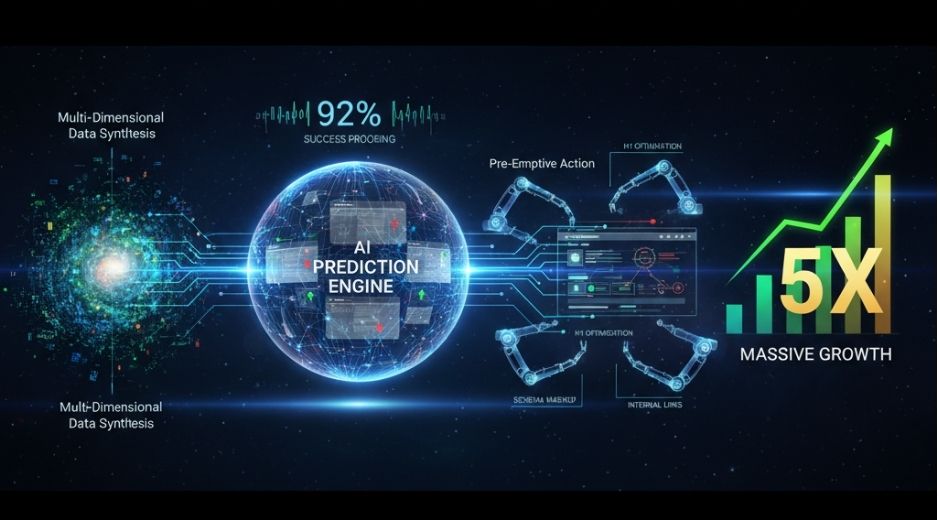
1. Stage 1: Multi-Dimensional Data Synthesis
Our Quantum engine gathers and analyses data in parallel—a capability humans cannot replicate at scale. Instead of looking at individual signals, we look at their covariance (how they affect each other).
Internal Site Health: The engine continuously monitors proprietary data like indexation rates, crawl patterns, server logs, and the semantic coherence of your content clusters. It flags content that is showing an early “decay signature” before rankings reflect the issue.
Competitive and Market Signals: We track competitor content publishing schedules, backlink velocity patterns, and changes in their information architecture. Crucially, the engine also analyses large external market data sets, such as search behaviour volatility tied to industry news or economic indicators, allowing us to predict when a niche topic is about to explode in demand.
Algorithmic Forensics: The model uses machine learning to identify “pre-update jitters”—subtle, high-frequency ranking movements across unrelated keywords that often signal an impending Google algorithm adjustment.
2. Stage 2: Probability and Risk Modelling
Based on the synthesis of these inputs, the AI generates a time-bound probability score for every key transactional page on your website.
Risk Scoring: The engine assigns a score, such as “78% probability of losing position 3 on this key term within 21 days due to a competitive gap in E-E-A-T.” This score is based on the combined weight of several factors (e.g., competitor content quality, your missing schema, and a slowdown in your internal linking).
Opportunity Scoring: Conversely, it may score an underperforming pillar page with an 85% probability of ranking in the top 5 if two specific changes are made immediately.
This quantification eliminates guesswork. We don’t act on a hunch; we act on a mathematically derived probability of success or failure.
3. Stage 3: Automated Pre-Emptive Optimisation
Once a high-probability risk or opportunity is flagged, the system initiates the pre-emptive optimisation sequence. This is the crucial proactive step that protects your investment:
Risk Mitigation: If a drop is predicted, the AI immediately delivers a prioritized list of interventions: “Add
Reviewschema to this page, rewrite the H2 to match the new intent discovered, and inject 4 high-authority internal links from these specific pages.” This work is completed before the competitor’s content has time to fully index and impact your rankings, effectively minimising the predicted loss.Opportunity Seizure: If a surge in market demand is predicted, the engine flags the necessary gap-filling content, ensuring your content is fully optimised for semantic depth and citation-readiness. This ensures your site captures the majority of the new traffic instantly when the demand hits.
By operating in this predictive cycle, Quantum SEO transforms your budget from being spent on recovering lost traffic (reactive) to consistently protecting and capturing high-value traffic (proactive), leading to a significant maximisation of your overall organic ROI.