
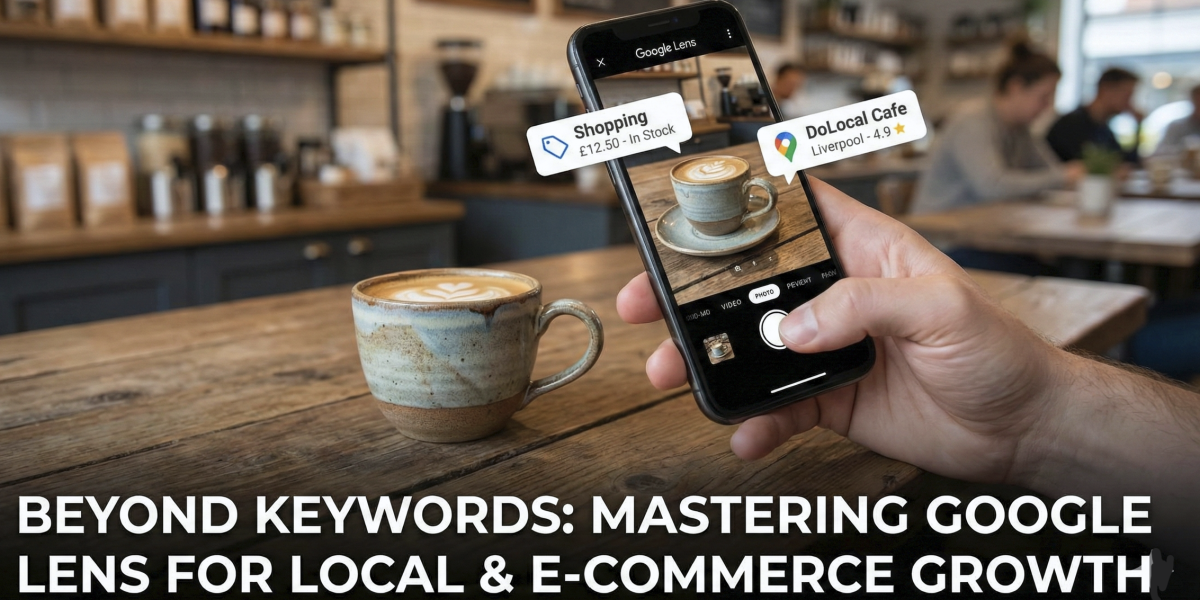
Beyond Keywords: Mastering Google Lens for Local SEO and E-commerce Growth
The era of text-only search is drawing to a close. For decades, e-commerce and local discovery relied on a user’s ability to transcribe their visual desires into keywords. We were forced to type “vintage brass lamp green shade” and hope the search engine understood.
Today, that friction is gone. With tools like Google Lens and Circle to Search now facilitating nearly 20 billion visual searches monthly, the camera has become the new keyboard. For businesses across the UK, this shift requires a fundamental pivot in SEO strategy—moving from purely keyword-centric optimisation to a holistic Visual SEO approach.
At DoLocal, we are seeing a direct correlation between high-fidelity visual assets and local search visibility. Here is how your business can dominate this new frontier.
The Mechanism: How Google Lens “Reads” Your Business
Google Lens does not just “see” pixels; it analyses semantic meaning. Powered by advanced computer vision and the Shopping Graph (which now houses over 45 billion listings), it breaks an image down into entities: shapes, colours, text (via OCR), and spatial relationships.
It then cross-references this data against:
The Knowledge Graph: To identify landmarks, storefronts, and logos.
The Shopping Graph: To match products with inventory, pricing, and reviews.
Local Listings: Matching storefront visuals with Google Business Profiles.
The Optimisation Protocol
To ensure your products and premises are discoverable via Lens, you must adhere to a strict visual schema:
Semantic Image Clarity: Ensure the subject occupies at least 75% of the frame. Avoid cluttered backgrounds that confuse the object-detection algorithms.
Structured Data (Schema): This is non-negotiable. You must implement
Product,Offer, andLocalBusinessschema. Google Lens uses this code to overlay pricing and availability directly onto the visual search result.EXIF & Metadata: Embed geolocation data (vital for local SEO) and descriptive IPTC metadata into your image files before uploading.
Frequently Asked Questions regarding Visual SEO
How does Google Lens fundamentally change the traditional keyword research process for our business?
Google Lens shifts the paradigm from “keywords” to “entities” and “visual intent.” In traditional SEO, we research specific phrases users might type, such as “red leather boots UK.” In the visual search landscape, the “keyword” is the image itself. Therefore, the research process must evolve to focus on Visual Query Analysis.
Instead of asking “What are users typing?”, we must ask “What are users photographing?” and “What visual attributes does Google associate with my product category?”. If you sell furniture, traditional keyword research might suggest targeting “modern oak coffee table.” Visual research, however, requires you to analyse the top-ranking images in Google Images and Lens results for that term. You may find that Google’s algorithm favours images taken from a specific angle (e.g., 45-degree isometric view) or those placed in a lifestyle context rather than on a plain white background.
Furthermore, “keywords” now exist as Alt Text and Image Context. The text surrounding an image on your website acts as an anchor for the visual AI. If an image of a product appears next to vague text, Lens may struggle to categorise it. Consequently, your on-page content must be descriptive and hyper-relevant to the visual assets it accompanies. We are essentially teaching the AI to associate specific visual patterns (your product) with specific semantic concepts (your target keywords).
What specific technical schema markup is essential for ensuring visibility in visual search results?
While standard SEO relies heavily on meta tags, Visual SEO for Google Lens is driven by Structured Data (Schema.org). Without robust schema, Google Lens can identify what an object is, but it cannot tell the user how to engage with it (e.g., buy it, visit the store, or book a table).
For e-commerce, the Product schema is critical. It must include nested properties like image, name, description, sku, and most importantly, brand. However, to truly excel in 2026, you must go deeper with the Offer property. This allows Lens to display the price, currency, and stock availability (InStock) directly in the visual overlay. If a user scans a pair of trainers in a physical shop, your result needs to instantly show that you have them in stock at a competitive price.
For local businesses (like those we support here in Liverpool), LocalBusiness and Restaurant schema are vital. You must mark up your “Menu” URL and link your “primaryImageOfPage” specifically to photos of your storefront or interior. There is also emerging value in 3DModel schema for products that support AR viewing. When Google Lens encounters a product with 3D markup, it prioritises that listing because it offers a richer user experience. Ultimately, schema transforms a static image into a transactional entry point.
How can local brick-and-mortar businesses leverage visual search if they don't sell products online?
It is a common misconception that Google Lens is purely for e-commerce. For brick-and-mortar businesses—such as restaurants, salons, or law firms—visual search is a powerful discovery engine driven by Local Intent.
Consider the “Multisearch” behaviour where a user snaps a photo of a dish and types “near me.” If your restaurant has high-quality, optimised photos of that specific dish uploaded to your Google Business Profile (GBP) and your website, Google can connect that visual query to your physical location.
Furthermore, Google Lens is heavily integrated with Google Maps. Users frequently scan storefronts as they walk down the high street to see reviews, opening hours, and busy times overlaid in Augmented Reality (AR). Therefore, your Storefront Optimisation is crucial. You must ensure that the exterior photos on your GBP match the current reality of your shop. If you repaint your facade or change your signage, you must update your digital imagery immediately. If the AI cannot match the visual reality of the street to your digital profile, you lose that traffic.
Service businesses can also capitalise on this by visualising their results. A landscaper should optimise before-and-after photos of their projects. When a homeowner snaps a photo of a neighbour’s garden they admire, Lens can surface your portfolio as a local professional who can achieve that look. Visual search bridges the gap between seeing a service in the real world and hiring the local expert who provided it.
Author Profile
Nadeem Ansari FCIM F IDM (Camb.) is a seasoned marketing professional with more than three decades of experience, specialising in integrated digital strategies. Nadeem holds an MBA in Marketing and fellowships with leading professional bodies. His expertise covers SEO, PPC, and data-driven marketing.
He is the known as the global pioneer of Quantum SEO.
For personalised consultation and digital marketing strategy development, contact Nadeem Ansari FCIM F IDM (Camb.) via DoLocal UK. https://dolocal.co.uk/team/nadeem-ansari/
